Pilot Application 5: Development of an AI-Based Inspection Assistant for Weld Detection

Development of an Assistance System for Optical Quality Inspection

Starting Point

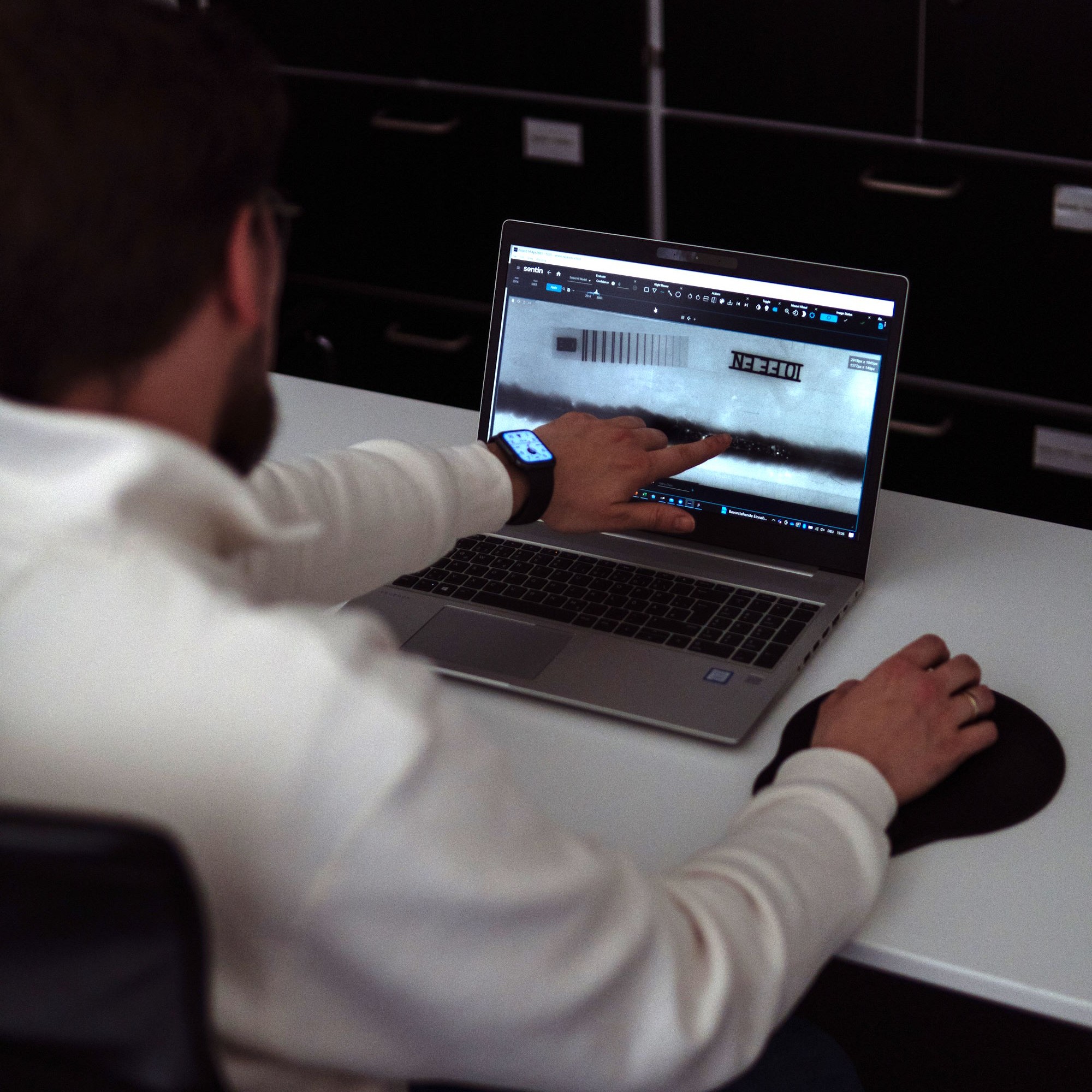
Sentin provides AI-powered assistance systems as a prototype application for HUMAINE, making the collaboration between humans and AI-based systems for interpreting large volumes of image data (e.g. X-ray images of welds) more reliable and faster than is possible today with human-based inspection alone. A pre-trained AI model for detecting common weld imperfections is embedded in a motivating and reliable software system that enables humans to interpret bulk weld image data faster and more reliably. The hybrid human-AI system should be able to inspect more accurately (probability of detecting the corresponding defect images in the weld), faster (time per image interpretation) and more reliably (continuous inspection quality over an inspection period) than the purely human-based version. Studies by BAM (Federal Institute for Materials Testing) can be used as a benchmark here.
Approach

  • User-centered interfaces for training AI solutions
  • Process model for identification- and acceptability-enhancing AI analysis and AI training

(INI)

  • Set of methods for developing adaptive and context-sensitive assistance systems in AI work systems and the use of AI to modify them

(LPS)

  • Job Change Acceptance Toolbox to increase acceptance of AI-related change processes
  • Guidelines for the design of internal communication with employees during the organizational development process, also with regard to satisfaction with the quantity and quality of the forms and content of communication
  • Criteria catalog for motivation-, identity-, and vigilance-enhancing human AI teaming workplaces
  • Job Perception Inventory (JOPI) for measuring workplaces supporting motivation, identity, and vigilance

(AOW)

Berretta, S.; Tausch, A.; Peifer, C.; Kluge, A. (2022): Messung von Wohlbefindens-, Motivations- und Identitätsförderlichkeit von Mensch-KI-Teaming- Arbeitsplätzen. Magdeburg (online): GfA-Press (Technologie und Bildung in hybriden Arbeitswelten, 39).

Berretta, S.; Tausch, A.; Ontrup, G.; Gilles, B.; Peifer, C.; Kluge, A. (2023): Defining human-AI teaming the human-centered way: a scoping review and network analysis. In: Frontiers in Artificial Intelligence 6, Artikel 1250725. https://doi.org/10.3389/frai.2023.1250725

Bülow, F.; Berretta, S.; Arnold, D.; Els, C.; Kuhlenkötter, B.: Human-Centeredness through Adaptation of AI Work Systems: Towards a Methodical Approach for Exploring the Design Space in Transdisciplinary Teams

Berretta, S., Tausch, A., Bülow, F., Kuhlenkötter, B., Topp, M., Els, C., Peifer, C., & Kluge, A. (2025). Human of AI first? A holistic perspective on the sequential order of joint human-AI inspection workflows. Applied Ergonomics, 132. https://doi.org/10.1016/j.apergo.2025.104669

Bülow, F.; Herzog, M.; Berretta, S.; Arnold, D.; Els, C.; Kuhlenkötter, B. (2026): Humanzentrierung durch Adaption von KI-Arbeitssystemen. In: I4S 1/2026: Angewandte KI-Ethik am Arbeitsplatz. Eine gemeinsame Verantwortung – von der Radiologie und Sprachtherapie bis zur Montage . Industry 4.0 Science.

Partners

Practice Partners

Research Partners

sentin

Christian Els
Christian Els

Ruhr Universität Bochum, Lehrstuhl für Produktionssysteme

Prof. Dr. Bernd Kuhlenkötter
Florian Bülow
Florian Bülow

Ruhr-Universität Bochum, Institut für Neuroinformatik

Prof. Dr. Laurenz Wiskott
Pavlos Rath-Manakidis
Prof. Dr. Tobias Glasmachers

Ruhr-University Bochum, Chair of Work, Organizational and Business Psychology

Prof. Dr. Annette Kluge
Dr. Sophie Berretta
Dr. Sophie Berretta

Universität zu Lübeck, Institut für Psychologie I

Prof. Dr. Corinna Peifer